


Hey everyone!
Today I wanted to cover a very important topic that caused me some confusion when I first started studying. I only got clarity on it when I had to implement it in a real project.
When designing networks on AWS, one of the most important decisions is defining how different environments will communicate securely, scalably, and cost-effectively.
AWS offers several options for private connectivity between resources, but three services tend to generate frequent confusion:
- VPC Peering
- AWS Transit Gateway
- AWS PrivateLink
At first glance, they seem to solve the same problem, but each one was built for completely different scenarios.
In this article we’ll analyze when to use each solution, their advantages, limitations, and practical examples from the day-to-day work of cloud architects.
Presenting the problem
Imagine a company with the following environments:
- Production Account
- Staging Account
- Development Account
- Security Account
- Shared Services Account
Each environment has its own VPC and now there is a need for communication between them. The question is:
How do you connect these VPCs the right way?
The answer depends on the purpose of the communication.
Not every situation calls for connecting the entire network. In many cases it is enough to expose just one specific service.
That is exactly where the differences between Peering, Transit Gateway, and PrivateLink come into play.
VPC Peering
VPC Peering creates a direct private connection between two VPCs. After the connection is created, instances can communicate using private IP addresses.
How it works
VPC A <-------> VPC B
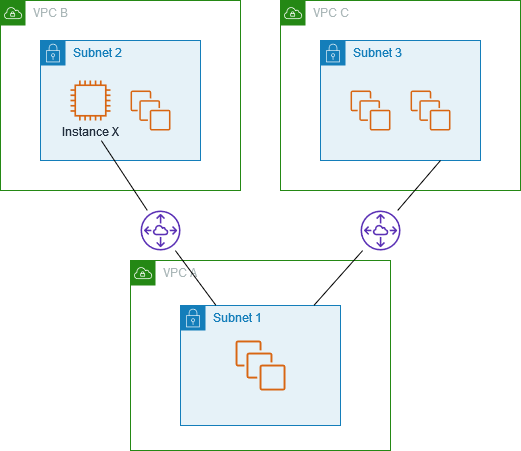
Traffic stays within the AWS network and does not travel over the internet.
When to use it
Peering works best when there are only a few VPCs that need to communicate. Examples:
- A Production environment accessing a Database VPC
- Two applications that share internal services
- Simple communication between different accounts
Advantages
- Simple to set up
- Low latency
- No single point of failure
- No additional appliance or gateway required
Limitations
No transitive routing
Consider:
VPC A <--> VPC B
VPC B <--> VPC C
VPC A cannot reach VPC C through VPC B.
You need to create another Peering:
VPC A <--> VPC C
Exponential growth
With just a few VPCs it works great, but imagine 20 VPCs fully interconnected.
The number of connections grows quickly.
N x (N-1) / 2
20 VPCs = 190 Peerings
Management becomes complex.
Real-world scenario
A company has:
- Application VPC
- Database VPC
Only these two networks need to talk to each other.
In this case, VPC Peering is usually the simplest and most cost-effective solution.
AWS Transit Gateway
Transit Gateway was built to solve the scaling problem of Peering.
It works as a central connectivity hub.
How it works
           VPC A
             |
             |
VPC B ---- TGW ---- VPC C
             |
             |
           VPC D
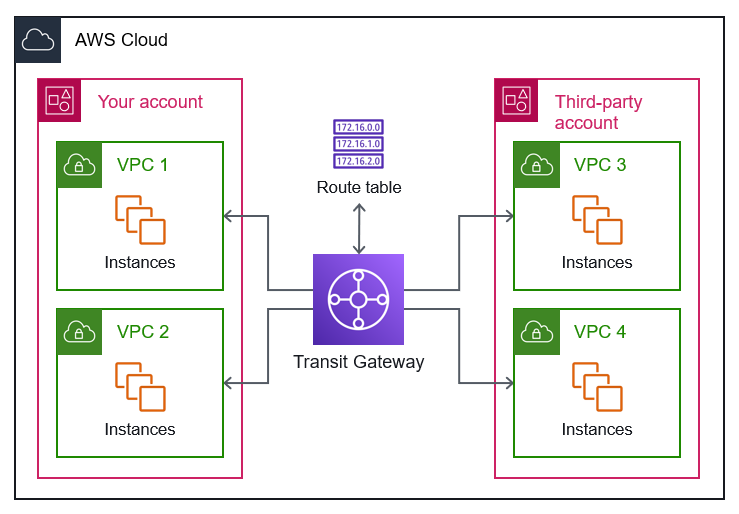
All VPCs connect to the Transit Gateway and routing happens through it.
When to use it
Ideal when there are many VPCs. Examples:
- Multi-account environments
- AWS Organizations
- Landing Zones
- Large enterprise environments
Advantages
Scalability
Adding a new VPC requires only a new attachment.
There is no need to create dozens of Peerings.
Transitive routing
Unlike Peering:
VPC A -> TGW -> VPC B
VPC A -> TGW -> VPC C
All of them can communicate as allowed by the route tables.
Integration with on-premises networks
The Transit Gateway can aggregate connections from:
- Site-to-Site VPN
- AWS Direct Connect
- SD-WAN
Governance
Very useful for platform teams and Cloud Centers of Excellence.
Enables centralized connectivity control.
Limitations
Cost
Charges apply for:
- Attachments
- Processed traffic volume
For small environments it may cost more than Peering.
Complexity
Requires understanding of:
- TGW Route Tables
- Attachments
- Traffic segmentation
Real-world scenario
A company has:
- 50 AWS accounts
- Production environment
- Staging
- Development
- Security
- Shared Services
Creating Peerings between all VPCs would be unmanageable. Transit Gateway becomes the natural architecture.
AWS PrivateLink
PrivateLink solves a different problem.
It was not built to connect networks — it was built to expose services. This is the key difference that often confuses certification candidates.
How it works
Imagine there is an API running in VPC A.
VPC B needs to consume that API.
With PrivateLink:
Consumer
(VPC B)

     |
     |
Endpoint
     |
     |
PrivateLink
     |
     |
NLB
     |
     |
Service
(VPC A)
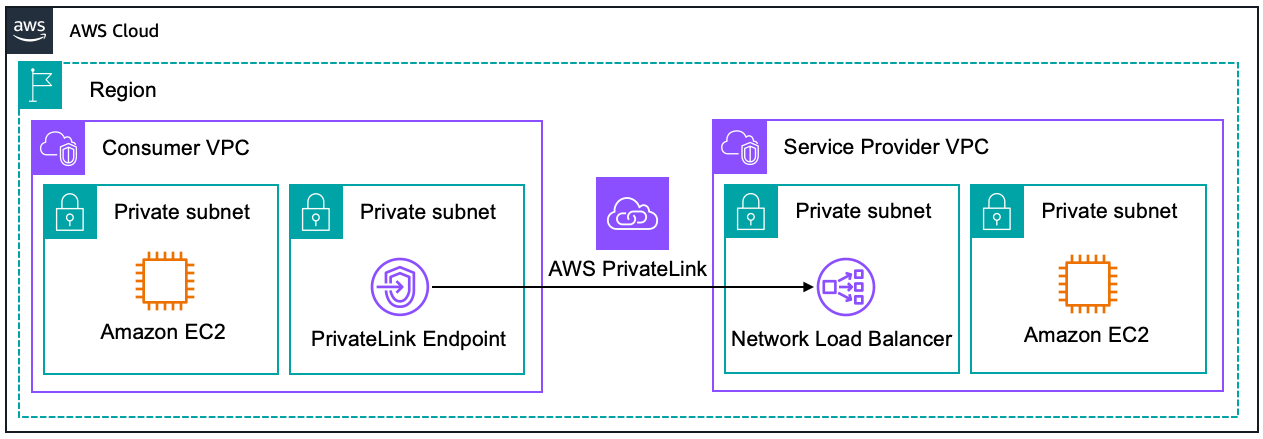
The consumer accesses only the service — it does not gain access to the entire network.
When to use it
Whenever you want to share a service without sharing the VPC.
Examples:
- Internal APIs
- SaaS services
- Corporate databases
- Shared tools
Advantages
Smaller attack surface
The client cannot see:
- Subnets
- Routes
- Internal resources
Only the published service.
Isolation
There is no full connectivity between VPCs.
Only access to the defined endpoint.
Cross-account sharing
Widely used by SaaS providers.
Limitations
Does not replace network connectivity
If you need to access multiple resources in a remote VPC, PrivateLink is probably not the right solution.
Requires an NLB
The published service normally sits behind a Network Load Balancer.
This adds components and costs.
Real-world scenario
A central team provides a corporate authentication service.
Dozens of AWS accounts need to consume that service. Granting full VPC access would be a security risk.
With PrivateLink, each consumer accesses only the required API.
Quick comparison
| Feature | VPC Peering | Transit Gateway | PrivateLink |
|---|---|---|---|
| Connects full networks | Yes | Yes | No |
| Shares only a single service | No | No | Yes |
| Scales to dozens of VPCs | No | Yes | Yes |
| Transitive routing | No | Yes | Not applicable |
| On-premises integration | Limited | Excellent | No |
| Complexity | Low | Medium/High | Medium |
| Best for | Few VPCs | Many VPCs | Sharing services |